
Bitescize is our series of interviews, where top academics and practitioners will be answering our questions on #BehavioralScience, #Misinformation and #StratComms 👀.
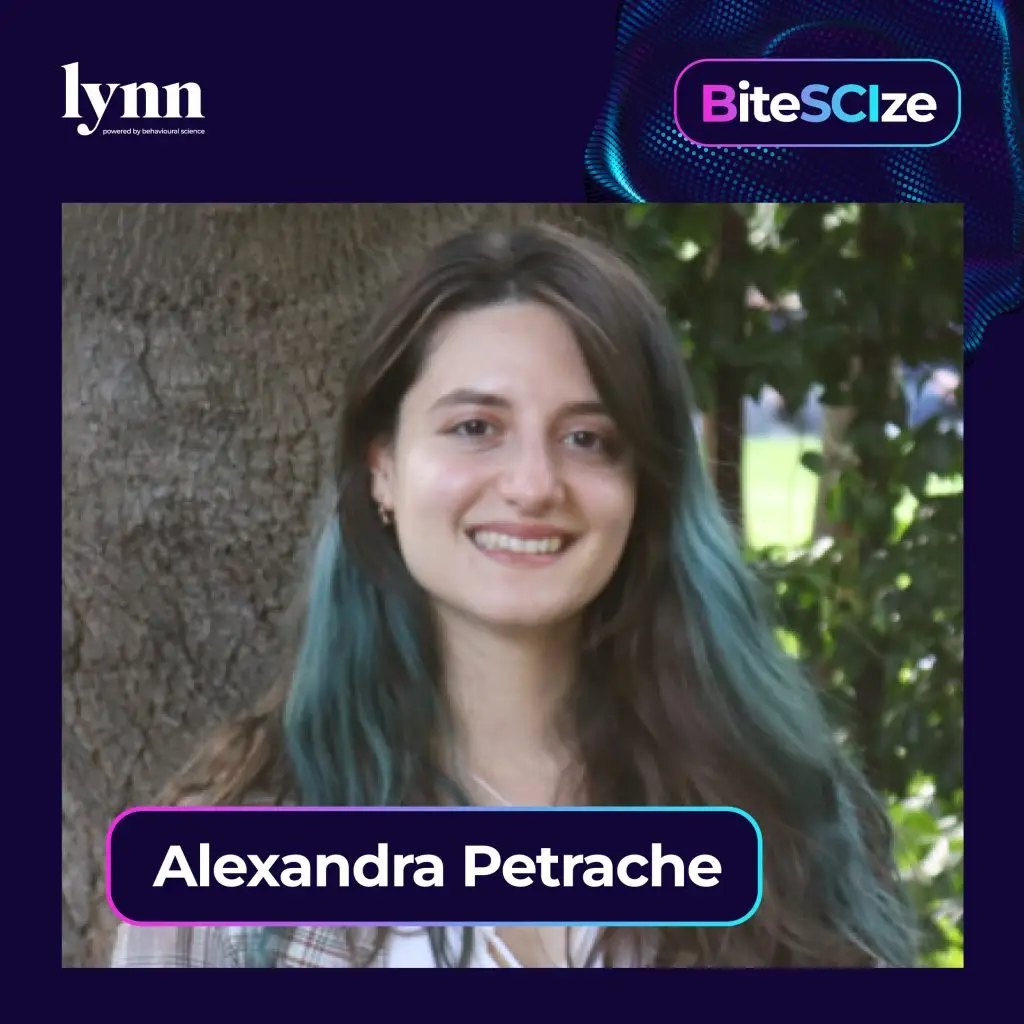
For the first Bitescize of the year, we talked to Dr Alexandra Petrache, applied behavioural scientist at @ Behavioural Science and me and neuroscientist. Alexandra told us about her passion for understanding human behaviour, and her vast experience in all things behaviour change and healthcare. You can listen to her podcast here: Behavioural science and me

Who are you?
I am an applied behavioural scientist and a neuroscientist. I love storytelling, arts and sciences, and I am driven by purposeful work.
How did you get into Behavioural Science?
Up until recently I thought that my interest in behavioural science started around high school, when I began to read behavioural science literature. However, I realise that it had started as an even earlier age, maybe when I was a child and put clear labelling on the recycling and waste bins in my neighbourhood, wanting to make sure that the different types of waste were clearly indicated. You can hear more about this in the first episode of my podcast, “Behavioural Science and me”.
What are you working on right now?
Just before writing this I had finished a proposal for a public health project concerning vaccinations and ways in which healthcare professionals communicate with their patients about vaccinations.
What do you like most about what you do?
Honestly? The fact that I am able to do it – the fact that I am able to work to better understand people and why we do the things we do, as well as what works for us. I love the breadth of projects I can get involved in: from improving clinical trial experience, to marketing campaigns, or understanding drivers and barriers to treatments in a rare disease. That’s because I look to spot opportunities for behavioural science everywhere and I work to truly understand a problem before diving into how to solve it. This means work is never boring!
What role is there for communications in changing behaviour?
A vital role. To be effective, communications need to take into account the particular context of the behaviour that needs to change, and the influences on it, be it internal or external. The channel of communication is extremely important. It is fascinating to see how people from different groups (e.g., culture) use and spread communications.
They can be a tool for good and, as we have seen, a tool for evil, as well, and in the digital age, ill-devised miscommunications can spread very fast. That’s why we have a duty to, as much as possible, put out communications rooted in fact and in context.
On the flip side, a company looking to design effective communications should absolutely involve a behavioural scientist to carry out a thorough analysis on what is likely to resonate, why, how, who the messenger should be, etc. And to do some testing, if possible.
If you could work on / research any topic what would it be and why?
I would like to merge my passion for healthcare and sustainability with my support for social justice. Perhaps looking at how accelerated climate change affects health inequitably, or how mis- and dis- information (especially via digital means) breaks communities and what repercussions there are. I am working on a podcast episode in this area.
What is your favourite behavioural science paper/book/resource and why?
Everything that comes out of the UCL Centre for Behaviour Change and the United Nations. The resources are clear, comprehensive, and they build a feeling of purpose.
Who do you think is interesting in the general field?
This is a very difficult question, as I have connected with and follow the careers of so many interesting behavioural scientists. Purely filtered through my appreciation of the COM-B model and the Behavioural Change Wheel, I would say Professor Susan Michie from UCL.
There are others I appreciate, as well, for various reasons: Natalia Le Gal (for her cool behavioural science-themed cartoons), Cláudia Simão (for sharing so many free resources), Massimo Ingegno for his interesting work on the MakeItToolkit.
What haven’t we asked you that we should have?
What the biggest challenge for behavioural science is. I would love to know the reader’s opinion.
Who is one person that we can speak to for our next interview and if you could ask them one question, what would it be?
Can I give you two people? Jessica Walburn (IQVIA) and Katy Irving (HRW). I’d love to ask both of them where they see themselves in 5-10 years, from the perspective of working in behavioural science.